
I want to begin my introductory editorial comments with the expression of much gratitude to all my predecessors, especially the most immediate, Rev. Dr. Jin Hee Han whose calm yet compelling call to me to …
Read the full story »I want to begin my introductory editorial comments with the expression of much gratitude to all my predecessors, especially the most immediate, Rev. Dr. Jin Hee Han whose calm yet compelling call to me to serve as General Editor I could not decline. To the Board and staff of the Living Pulpit, I say, “thank you” for your devotion, diligence and support which have kept this publication alive in the face of all the strong headwinds hitting many such journals. Many thanks go to our contributors and readers whose continued interest and faith in this publication gives us the confidence to continue creating the space and opportunity for dialogue on important matters. My special thanks go to the Managing Editor, Alet Brown, who worked exceptionally hard to put together these insightful and inspiring essays for this Spring 2021 issue of The Living Pulpit.
This issue focuses on sustainability, a key scientific and socio-economic issue in need of much theological reflection. To initiate some theological discussions on sustainability, the essays and book review draw attention to the groanings of creation. Our “mother earth” cries out against the abusive treatment of its eco-systems – water bodies, vegetation, climate etc. Yet we humanity, the chief perpetrators of these abuses, continue in our wanton destruction and creation of disequilibrium through over consumption, over exploitation of resources and the general lack of care for the universe.
Much of humanity’s uncaring attitudes towards their home planet earth and creation in general, as pointed out by some of the authors, are largely the result of anthropocentric notions of humanity drawn from biblical texts and reinforced by simplistic and often literal Judeo- Christian interpretations of them. Biblical texts such as, “Be fruitful and multiply and fill the earth and subdue it. Rule over the fish in the sea and the birds in the sky and over every living creature that moves on the ground.” (Gen. 1:28), “Look at the birds of the air; they neither sow nor reap nor gather into barns, and yet your heavenly [Parent] feeds them. Are you not of more value than they?” (Matt. 6:26; Luke 2:24) are notoriously interpreted to suggest that humans are the most favored among God’s creation and thus have been given control over everything in the universe. These and other such dubious interpretations are interrogated in a couple of the essays.
Sustainability (sustainable development), according to UN World Commission on Environment and Development is, “development that meets the needs of the present without compromising the ability of future generations to meet their own needs.” This must be the goal of all humanity especially as we deal with food insecurity, drought, wildfires, and many elements of global climatic change.
Hopefully, the essays in this issue will contribute to and further ongoing discussions on sustaining our universe.
Moses O. Biney
Editor in Chief
The Preacher’s Guide on Pesky Passages by Rev. Dr. Jin H. Han
Sustainability and Sacrifice: An Eco-Theology of the Cross by Lisa Jarnot
Book Review: For the Life of the World: Theology that Makes a Difference by Dr. John W. Herbst
Bible …

“The earth is the LORD’s and all that is in it.”–Psalm 24:1
When Professors Mary Tucker and John Green of the Forum on Religion and Ecology (currently at Yale University) were working on a project of …
On any given evening in any urban neighborhood in the United States, it is possible to forage through grocery store dumpsters for an array of food worthy of the tables in Solomon’s Temple. Thousands of …

Miroslav Volf and Matthew Croasmun. For the Life of the World: Theology that Makes a Difference. Grand Rapids: Brazos Press, 2019. Pp 196. ISBN 978-1-58743-401-3. $21.99 hardback.
For the Life aims to motivate us to focus our theology on …
The earth is the Lord’s
God called the dry land Earth, and the waters that were gathered together he called Seas. And God saw that it was good.
Gen. 1:10
Then God said, “Let the earth put forth …
The Earth is…
The whole earth is a living icon of the face of God.
— St. John Damascene (749 AD)
Everything that is in the heavens, on earth, and under the earth is penetrated with connectedness, penetrated …
According to Psalm 24:1, “the earth is the Lord’s, and all that is in it, the world, and those who live in it.” Typically, this type of ownership implies that the owner is personally responsible …

Shamans have been known to be one of the foundational healing components to any development of community. Don Jose Ruiz, a Toltec Shaman from Southern Central Mexico, defines a Shaman as a “nagual,” meaning the awakened …

Through the writings of Holy Texts and the lens of Eco-theology, humanity is called to manage and protect Mother Earth’s natural resources, ecosystems, climate, and atmosphere so that current and future generations, and millions of other species …
Dear Friends,
Many of our religious traditions have become silent or subdued regarding the once-robust theme of divine justice. Some of us might recall the days of the Great Awakening, which gave us the passionate preacher …
The Arc and the Road: A Journey Towards a More Just Society by Rev. Dr. Neal Presa
Bible Quotes on Divine Justice compiled by Rev. Dr. Darla Dee Turlington
Quotes on Divine Justice compiled by Rev. Dr. …

The Rev. Dr. Martin Luther King, Jr. famously summarized the 19th century abolitionist Theodore Parker thus: “The arc of the moral universe is long, but it bends towards justice.”
The apostle Paul reminds us that God “reconciled …
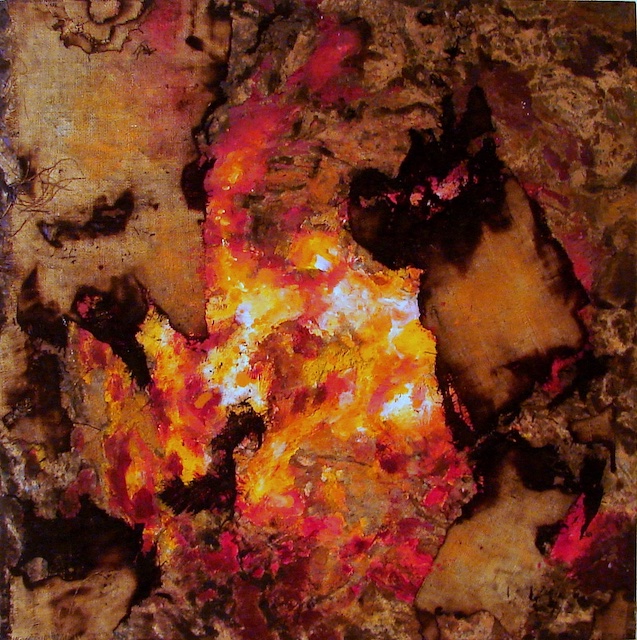
Title: Fish on Fire
Artist: Piety Choi
Size: 40"x40"
Mixed Media on Wooden Panel
This painting is based on the story at the end of the gospel of John in which the risen Christ came to his disciples on the morning of his resurrection and broiled the fish for them. To the wooden panel I attached the actual pieces of burnt burlap fabric and used acryl paint to reproduce a scene of broiling. While the Johannine passage is commonly understood as the risen Christ telling the world that he has risen and has returned to provide hope as well as hope-filled nourishment, I remember that fire also has the cleansing power of the fire of the Holy Spirit. According to other gospel traditions, Peter had denied Jesus three times. Jesus’ feeding of his disciples with the fish by the sea of Tiberias, however, has no trace of condemnation. In this scene, Jesus said to Peter, “Do you love me?” Jesus then asked Peter to tend his sheep. Divine justice might call to mind fire as punishment, but I cherish the power of the Lord’s fire that cleanses our soul from the stains of sin. There I see the path to renewal and new life.

If you would like to submit an article or book review for The Living Pulpit, email us at editor@pulpit.org.
The Living Pulpit (eISSN 1946-1771) is published quarterly by The Living Pulpit, Inc., 475 Riverside Drive Suite 500, New York, NY 10115, USA. Copyright © by The Living Pulpit, Inc. All rights reserved.